• Skip to primary navigation
  • Skip to main content
  • Skip to primary sidebar
  • Skip to footer
Logo: University of California Livermore Collaboration Center

UCLCC - University of California Livermore Collaboration Center

Sparking Conversations Where Innovation Thrives

  • Home
  • About Us
    • News and Events
    • History
    • Leadership
    • Anchor Programs
  • Host your event at UCLCC
    • UCLCC Request Form
    • UCLCC Post Event Survey
  • Student and Research Opportunities
    • Featured Opportunities
    • Programs
    • Centers and Institutes
    • Facilities
  • UC Affiliated Labs

News and Events

DOE’s Office of Science Is Now Accepting Applications for Spring 2026 Undergraduate Internships

July 9, 2025 by Garren Weiss

Students will conduct scientific and technical projects at national laboratories

The Department of Energy’s (DOE) Office of Science is now accepting applications for the Spring 2026 term for two undergraduate internship programs: the Science Undergraduate Laboratory Internships (SULI) program and the Community College Internships (CCI) program. The application deadline is October 1, 2025, at 5:00 p.m. EDT.

Through SULI and CCI, undergraduate students and recent graduates delve into science and technology careers at the DOE national laboratories. They gain new knowledge, skills, and professional experience to further their educational and career goals. Interns work directly with national laboratory scientists, engineers, and technical professionals. They assist these experts with science or technology projects that support the DOE mission, including new frontiers in artificial intelligence, quantum, nuclear energy and technology, critical minerals and materials, and fusion science and engineering.

SULI is open to full-time undergraduate students attending 4-year institutions and community colleges or recent graduates within two years of receiving their bachelor’s degree or associate degree. CCI is dedicated to supporting community college students. Both programs are stipend-based and offered three times annually in Fall, Spring, and Summer terms.

Two workshops are planned to introduce each program, including the application process and strategies for submitting a compliant application. 

  • August 6, 2025, from 2:00 – 3:00 p.m. EDT for CCI – Register on the CCI website
  • August 14, 2025, from 2:00 – 3:00 p.m. EDT for SULI – Register on the SULI website

In addition to the workshops, the program office invites applicants and letter of recommendation writers to attend office hours. At these times, DOE staff members will answer administrative questions such as those pertaining to uploading transcripts, submitting letters of recommendation, and general inquiries. Office hours are scheduled on September 4th, 11th, 18th, and 24th from 2:00 – 3:00 p.m. EDT. Registration (on the CCI and SULI webpages) is required for attendance. SULI and CCI are managed by the Office of Workforce Development for Teachers and Scientists (WDTS) in the Office of Science. More information can be found at https://science.osti.gov/wdts
Filed Under: Featured Opportunity, Homepage News, News and Events

UCLCC-Hosted Grad School Fair a High Energy Success

July 8, 2025 by Garren Weiss

By Caroline Liu (UCLCC Communications Intern 2025)

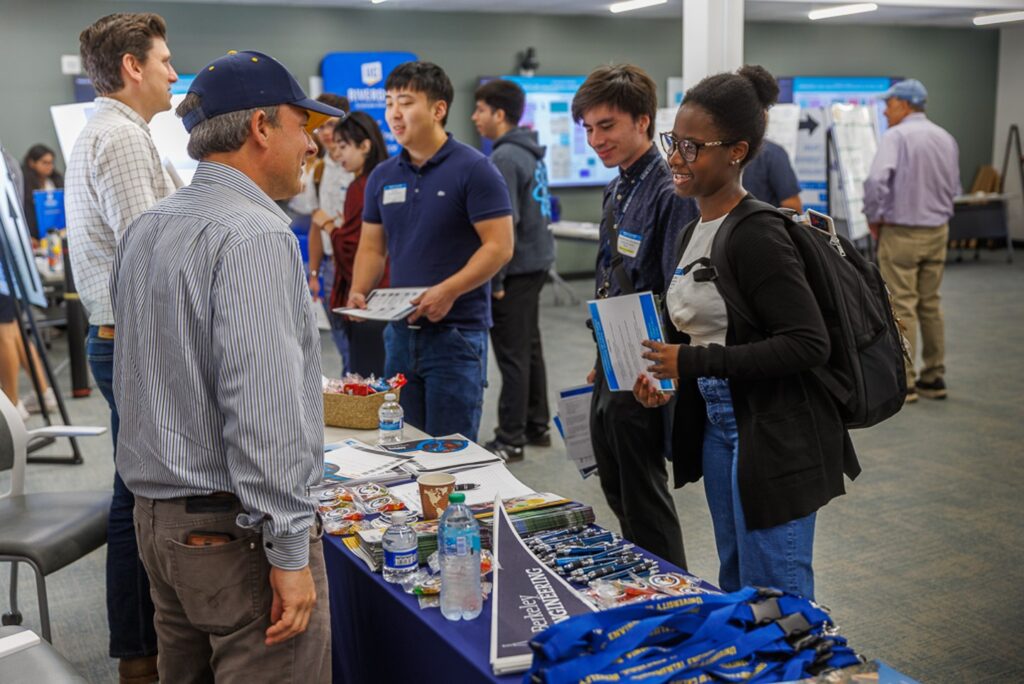
On July 8, 2025, the UC Livermore Collaboration Center (UCLCC) hosted its first ever UC Graduate School Fair. The event provided a rare opportunity to bring together representatives from nine University of California campuses, leaders from the Krell Institute and interns and employees from Lawrence Livermore National Laboratory (LLNL) and Lawrence Berkeley National Laboratory (LBNL). The day marked yet another way to leverage UCLCC’s ability to foster cross collaboration among the UC campuses and three National Laboratories – and, in turn, inspire the next generation of scientists and engineers.

Emphasizing The Fields That Will Lead the Future

The fair was especially focused on scientific and technological disciplines that will be essential in the near and long-term future, including engineering, physical sciences and high energy density science. The nine UC campuses (Berkeley, Davis, Irvine, Los Angeles, Merced, Riverside, San Diego, Santa Barbara and Santa Cruz) brought representatives from those and related fields, including deans, vice provosts, assistant and associate professors, graduate students and staff. They were joined by LBNL and LLNL employees and representatives from the Krell Institute, a non-profit organization that provides U.S. Department of Energy-funded graduate fellowships to support students interested in pursuing doctoral degrees in fields using high performance computing.

Throughout the day, laboratory interns and employees engaged one-on-one with UC campus representatives to discuss the resources and support available to pursue graduate studies. This included learning more about the graduate application process, scholarship and fellowship opportunities and other unique pathways to higher education.

The intimate setting also allowed attendees to get their questions answered, network with current UC faculty from the different campuses and see current graduate student’s research and individual paths to graduate school. De’ja Bailey, an LLNL intern, was grateful to have had the “opportunity to connect with lab staff, University of California representatives, and other student interns.”

Three Formal Sessions

In addition, to informal networking, the event held three formal sessions. The first focused on UC Admissions, scholarships and the lab’s Employee Tuition Assistance Program (TAP). People directly in charge of those programs provided in-depth information on graduate admissions and ways to help fund higher education, including financial assistance for those interested in pursuing higher education while working at one of the national laboratories.

The second session was a panel that sought to dispel the mysteries of graduate school. Faculty members and their graduate students shared their unique, often non-linear journeys. The pairings of professors with their students also allowed participants to see the mentor-student relationship, a key factor in shaping academic success. “I appreciate hearing people’s own experience and hearing their personal journey on how they got to graduate school,” said Sofia Malmhall, a second-year intern at LLNL.

At the third session, employees from LBNL and LLNL showcased their career paths as part of an effort to have the UC graduate students learn about career opportunities at the labs. During this session, the lab employees and graduate students also had the chance to spend time speaking more informally about research and career paths. “The UC Grad School Fair was such a great opportunity to connect with so many bright students and interns from diverse research backgrounds,” said Xiaoxing Xia, a staff scientist at LLNL who spoke as a panelist. “After the panel, I had great conversations with UC faculty members and fellow panelists, which sparked many ideas for new research collaboration as well as institutional partnership.”

The day concluded with a reception, providing yet another opportunity for participants to informally connect with each other, discuss their research and explore potential opportunities for collaboration. It capped a highly successful day, in which UCLCC’s three buildings, six conference rooms and expert staff facilitated the kind of synergistic effort that has been the goal of the facility since its inception.

Filed Under: Featured Opportunity, Homepage News, News and Events

Department of Energy Awards 38 Million Node-Hours of Computing Time to Support Cutting-Edge Research

July 8, 2025 by Garren Weiss

The U.S. Department of Energy’s (DOE) Office of Science today announced that it will award over 38 million node-hours to 56 scientific projects under the Advanced Scientific Computing Research (ASCR) Leadership Computing Challenge (ALCC) program. The projects will use DOE supercomputers to solve problems that would otherwise be impossible using experimental approaches alone. The selected projects span many applications, ranging from advancing nuclear fusion to developing foundational models for AI.

The ALCC allocates researchers time on DOE’s world-leading supercomputers to advance U.S. leadership in science and technology simulations. Because these facilities are unique, receiving computation time on these machines is highly competitive. The 2025 allocations provide time on supercomputers such as Frontier at Oak Ridge Leadership Computing Facility (OLCF), Aurora and Polaris at Argonne Leadership Computing Facility (ALCF) and Perlmutter at the National Energy Research Scientific Computing Center (NERSC). These resources represent some of the fastest computers in the world. Frontier ranks #2 and Aurora ranks #3 on the Top500 global list of most powerful computers. These resources are capable of calculating over a billion-billion calculations per second, which is the equivalent of every person on Earth doing one arithmetic calculation per second non-stop for four years, and will allow researchers to make discoveries and scientific breakthroughs far beyond those possible with traditional computers. 

“Department of Energy supercomputers provide the cutting-edge computational capabilities that advance U.S. scientific leadership. Our supercomputers enable the exploration of complex scientific problems and the development of new AI applications that speed the time to discovery,” said Ceren Susut, the Associate Director of DOE’s Advanced Scientific Computing Research program. “The ALCC awards are just one example of how the DOE’s investments in supercomputing benefit researchers all across our nation to advance our nation’s scientific competitiveness.”

ALCC focuses on projects with an emphasis on high-risk, high-payoff projects in areas relevant to the DOE mission or that broaden the community of researchers who use DOE’s advanced computing resources. For the 2025 awards, DOE selected projects based at 14 unique universities, 10 laboratories, and 8 industry partners.

These projects span a wide range of research areas addressing national challenges, such as: 

  • Energy: The development of AI and deep learning prediction tools for fusion energy systems, the modeling of materials for energy storage, and the design of new semiconductors. 
  • Medicine: The development of deep learning for medical applications, the modeling of cancer screening strategies, and the development of AI for cancer image processing.
  • Computational fluid dynamics: Simulations to enable optimized designs for next-generation turbomachinery with the potential to save airlines 130 million gallons of jet fuel annually.

Learn more about the 2025 ALCC awardees by visiting the ASCR website. The ALCC application period will re-open for the 2026-27 allocation cycle in Fall 2025.

Filed Under: News and Events

Annual workshop brings together signal and image science community

June 23, 2025 by Garren Weiss

On May 21 and 22, signal and image science experts from across LLNL, academia and industry gathered at the UC Livermore Collaboration Center (UCLCC) for the 29th annual Center for Advanced Signal and Image Sciences (CASIS) workshop. One of the longest-running events of its kind at the Lab, the CASIS workshop connects the signal and image sciences community to share research and resources, network and spark collaborations.

Signal and image sciences are a diverse and interdisciplinary field dedicated to processing, generating, analyzing and interpreting signals and images. This field is integral to the Lab’s key missions through activities like extracting data from National Ignition Facility (NIF) experiments, enhancing remote sensing capabilities for security applications, developing robust AI platforms for mission-critical decision-making and enabling quantum-computing systems.

“Given the breadth of applications, CASIS is uniquely positioned to provide a window into the Lab and showcase a large number of research areas,” said Ruben Glatt, CASIS director and AI Research Group leader in the Computational Engineering Division. “The workshop makes the Lab more approachable to the broader research community by helping identify overlapping interests and opportunities for collaboration.”

Filed Under: News and Events

LLNL, University of California host second-annual ALS workshop

June 10, 2025 by Garren Weiss

Amyotrophic lateral sclerosis (ALS) is a progressive and fatal neurodegenerative disease. While there is currently no cure, efforts are underway to change that — and to establish better treatments.

Scientists at Lawrence Livermore National Laboratory (LLNL) and the University of California (UC) system are addressing ALS challenges and opportunities at scale by collaborating across disciplines to accelerate research and development. Toward this end, the UC Livermore Collaboration Center hosted the second annual UC ALS Workshop on May 15–16.

Filed Under: News and Events

University of California Graduate School Fair

May 16, 2025 by Garren Weiss

LLNL Interns come and learn more about graduate school opportunities, degree paths, scholarships and more! Chat with current UC graduate students and admissions to dispel the mysteries of grad school.

This exciting event will host 9 University of California campuses and the Krell Institute. Participating campuses include: UC Berkeley, UC Davis, UC Santa Cruz, UC Merced, UC Santa Barabra, UC Irvine, UC Los Angles, UC Riverside, UC San Diego.

Schedule
10:30am – 11:30am Admissions and Scholarships Drop-in Session I
10:30am – 2pm Campus Information Booths
11:30am – 12:30pm Dispelling the Mysteries of Grad School
Informal chat with graduate students and advisors about their unique stories
11:30-1:00 Lunch Provided to Registered Attendees
1pm – 2pm Admissions and Scholarships Drop-in Session II

Located at the University of California Livermore Collaboration Center (B-661) uclcc.org 
If you have questions please email uclcc@ucop.edu

Filed Under: Featured Opportunity, News and Events

  • « Go to Previous Page
  • Page 1
  • Page 2
  • Page 3
  • Page 4
  • Interim pages omitted …
  • Page 7
  • Go to Next Page »

Primary Sidebar

Featured Opportunities Link

Footer

Logo: University of California Livermore National Laboratories